History
It began as the Grand Opera House…
Duluth’s Grand Opera House (1883-1889) served as Duluth’s cultural centerpiece and was home to the Chamber of Commerce, the Kitchi Gammi Club, and the Ladies Literary Library, the predecessor to the Duluth Public Library.
The Grand Opera House’s auditorium seated over 1,000 people. Duluth’s population was 13,000 in 1883, so the theater could seat nearly 8% of the entire city. On opening night (September 20, 1883), the Emma Abbott Opera Company performed the popular opera, “Martha” to a full house. On January 28, 1889, a fire claimed the Opera House, leaving the building in ruins. The theater was not rebuilt.
To the Temple Opera Block!
After the fire destroyed Duluth’s Grand Opera House, Duluth’s Masons ordered the construction of a new Masonic Temple at the site of their first temple, a two-story wooden structure built in 1869 at Superior Street and 2nd Avenue East. The new facility would include an adjacent opera house on 2nd Avenue East to take the place of the Grand Opera House.
The Mason’s occupied the top two floors of the Temple Opera Block and one floor of the Opera House. They first organized in Duluth in 1869, and JB Culver, Duluth’s first mayor, was also the first Master of Duluth’s “Palestine Lodge #79”.
Theater architect Oscar Cobb consulted on the Opera’s House design, including its extravagant 2nd Avenue entrance. On opening night, the Duluth Daily News described the building as: “Grand, imposing, beautiful! The Temple is indeed the ideal of the artist’s dream and the actor’s cherished hope. Beautiful in design, nothing of the practical has been sacrificed for effect, but rather has been made to lend to the beauty of the whole.”
The Temple Opera House auditorium included 18 private boxes in three tiers on each side. They were described as “marvels of beauty and comfort.”
Yet Another Fire
On October 12, 1895, another fire claimed the Temple Opera House, destroying the Mason’s Scottish Rite facility. Newspaper reports say the entire building was lost within 30 minutes. A firewall prevented the fire from damaging the Temple Opera Block. After the fire, the Opera House site was left vacant for 10 years.
The Temple Opera House site was left vacant until 1905, when the Temple Rink — a roller skating facility designed by JJ Wangestein — was built, boasting a skating surface 140 feet long and 70 feet wide.
Vaudeville Takes Stage
Sometime prior to 1910, Duluth businessman Guilford Hartley purchased the Temple Opera Block at the site of the Temple Opera House. He also purchased the block of property east of the Temple Opera Block, from 207 to 213 E. Superior Street.Hartley also built the Orpheum Garage in 1912 on his property at 307-313 E. Superior Street. The Garage was adjoined to the Theatre and operated as a parking garage and included offices for the Theatre. It has more recently been referred to as the NorShor Annex.
On the Orpheum’s opening night (August 22, 1910), Mayor Marcus Cullum addressed the audience, told them they were “looking swell,” and then gave a short speech. The theater’s manager also claimed Duluth’s audience to be “more metropolitan than any I have seen outside of New York, Philadelphia, and Boston.”
The Orpheum was, until about 1925, Duluth’s premier vaudeville stage, competing only with the Lyceum Theatre for quality acts. As a member of the nationwide Orpheum Theatre circuit, Duluth’s Orpheum was all but guaranteed to book the nation’s finest talent. Famous vaudeville acts included WC Fields and his juggling act, Mary Pickford, The Marx Brothers, Jack Benny, and Charlie Chaplain.
In 1929, the Orpheum’s main entry was moved to 207 E. Superior Street, the first bay of the Orpheum Garage. The 2nd Avenue awning was also relocated to Superior Street at that time and a large vertical sign for the Orpheum was attached to the Temple Opera Block.
A 5-Year Intermission
From 1934 to 1939, the theater was closed except for a few sporadic attempts to make it work as a venue for live theatre and movies.
The NorShor Theatre is Born
In 1940, the Minnesota Amusement Company leased the Orpheum Theatre and the Orpheum Garage, then hired architects to convert the Vaudeville theater into a modern, art deco movie house.
After a major renovation, in which the Orpheum’s layout was completely reversed, the 2nd Avenue and Superior Street Orpheum entrances were abandoned and a new entrance at 211 Superior Street was installed for the brand new NorShor Theatre. A Duluth News Tribune story about the theater stated that “The Northwest’s most spectacular theater…features an entirely new style of theater architecture, a style so radical from accepted standards that the NorShor has already earned the distinction of being more sensational than New York’s Radio City.”
The NorShor opened with Bob Hope and Dorothy Lamour in “Caught in the Draft,” in which Hope reluctantly joins the US Army.
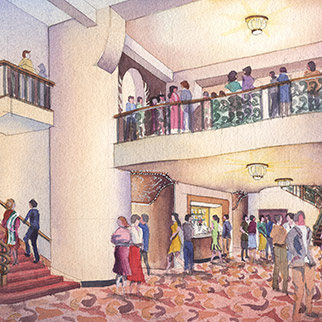
The NorShor boasted the largest screen in the “northwest.” The main auditorium held 1,100 seats and the balcony held 300. The lobby housed a “hall of mirrors” and the building’s amenities included “an ultra modern powder puff room, modern rest rooms, and personalized service.” A snack bar was added to the “Hall of Mirrors” sometime after opening night and it was placed along the east wall across from the south stairway near the auditorium entrance. The NorShor also boasted the first “Milk Bar” that served only dairy products.
Most notably, the NorShor’s tower marquee stood 65 feet above the theater, weighed over 300 tons and was completely sheathed in porcelain. It used 3,000 lights and was said to be visible from 60 miles away. In 1942, the Harley Company had the Temple Opera Block’s top three floors and Moorish dome removed and is theorized that the building was shortened at the request of NorShor’s management so the Temple Block’s Moorish Dome wouldn’t compete for attention with the NorShor’s brightly lit tower. Claiming maintenance costs, the Hartley Family Trust had the NorShor’s tower removed on March 8, 1967.
In 1974, Minnesota Amusement Co., gave up its lease to the NorShor. It was then operated by Pitt Theaters, and after that, the Cinema Entertainment Corporation ran the theater until sometime before 1982. In 1976, the Hotel Duluth Corp. purchased the NorShor/Orpheum/Garage buildings and the Temple Opera Block and then sold the buildings to Daniel H. Neviaser in 1977.
New Ownership
The NorShor was then purchased in 1982 by physician Dr. Erik Ringsred and his wife Deborah thru 2010, and a number of operators took the reins of the NorShor.
Then, on June 15, 2010, the Duluth Economic Development Authority (DEDA) purchases the NorShor Theatre and Temple Opera Block, and the Duluth Playhouse assumes the theater’s management. The intent was to return the NorShor to life as a vibrant cultural center — serving the needs of the arts, dance, theatre and musical organizations from across the region.
The Start of the NorShor Theatre Restoration Project
In 2012, DEDA selected developer Sherman Associates and the Duluth Playhouse, as a part of an RFP asking them to join forces to oversee the transformation of the theater, and future management of the facility. Each bringing expertise in their respective fields, this powerful partnership crafted a compelling vision and plan for the project. Together they will direct the rehabilitation of the NorShor Theatre, the Temple Opera House, and the Annex Buildings, creating a state-of-the-art, 605-seat facility in the heart of Duluth.
Why This Project Matters
- A stabilized restored NorShor Theatre and its surrounding buildings will bring vital economic growth and development to the city’s center.
- It will provide a much-needed mid-sized venue that will offer a state-of-the-art facility for national, regional, and local, performers.
- A vibrant cultural community creates an enhanced quality of life for residents, strengthens the city and our surrounding region.
- The NorShor will be one more reason tourists will consider Duluth a destination of choice.
- As a landmark in downtown Duluth, the NorShor Theatre played a significant role in our city’s history, and in the lives of so many of our residents. Restoring it to its grandeur as a center for arts and entertainment will bring a wide variety of new performances from local, regional, and national performers, and the opportunity for new experiences and memories for generations to come.
 View the Project Gallery > Donate Show your support
 »